Overview
What this menu has to do
A catering menu is read by someone spending other people's money, weeks before the event, usually while comparing you with two others. It is a proposal more than a menu, and it is judged on how completely it answers questions.
Keep the four sections, adjust the counts to your kitchen, and write each dish once — name, description, price, allergens — so the same entry works in a quote, on the day and in a link you send a client to review.
Structure
The categories, in reading order
Keep the order, adjust the counts to your kitchen.
- 01
Canapés
8–14 itemsPriced per piece and chosen by count rather than by appetite. Say how many pieces per person a reception usually needs.
- 02
Buffet mains
6–10 dishesThe centre of the quote. Say what each dish serves, because a client is calculating headcount, not portions.
- 03
Dietary options
4–8 dishesA section, not a substitution note. Every event has guests who eat differently, and a client who cannot find this assumes you cannot handle it.
- 04
Packages
3–5 packagesWhere the decision is actually made. Show what each package includes per person, and what pushes the price up.
Worked example
What one finished entry looks like
One dish from each category, written the way a guest should read it.
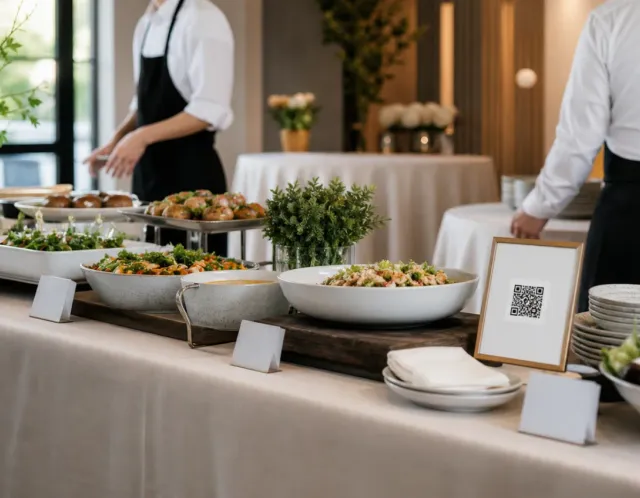
This is how the same four entries reach a guest: one page, opened from a QR code or a link.
Example content for illustration. Prices are shown with the same formatting a published ListoQ menu uses.
Writing notes
Three things worth getting right
Say what a dish serves, not how it tastes
A client is doing arithmetic, not imagining flavour. “Serves eight” is worth more on a catering menu than any adjective you could put beside it.
Dietary options are a section, not an asterisk
Every event brief asks about them. Answering in a dedicated section, with the 14 EU allergen categories tagged per dish, removes a whole round of email.
Price per person and per platter
Clients budget per head but order per platter. Showing both stops the conversion happening in a spreadsheet you never get to see.
Questions
Common questions about this menu
- How should catering prices be shown?
- Both ways: per person on packages, and per platter or per piece on individual dishes. Clients budget by headcount but order by unit, and a menu showing only one forces them to do the conversion themselves.
- How many dishes should a catering menu offer?
- Between 25 and 40 across all four sections. The counts on this page add up to that range, which is broad enough to cover most briefs without implying you cook everything equally well.
- Do catering menus need allergen information?
- Yes, and more visibly than most. In the EU, information about the 14 named allergen categories has to be available for every unpackaged dish, and event clients are usually collecting it for their guests well in advance.
- How do I share the catering menu with event clients?
- Send the menu link in your proposal or email. The link always opens the current version, so a client who saved it weeks ago still sees today's dishes and prices.
- How do I show package prices for different guest numbers?
- As one package with a size for each tier, such as for 20, 50 or 100 guests, each with its own price. Clients see every tier at once and pick the one that fits their event.
More templates
Other menus you may be building
- Restaurant menu templateA restaurant menu structure you can start from: four categories, how many dishes each should hold, and a worked example with prices and allergen labels.
- Cafe menu templateA cafe menu structure you can start from: four sections, how many items each should hold, and a worked example with prices and allergen labels.
- Coffee shop menu templateA coffee shop menu structure you can start from: four sections, how many items each should hold, and a worked example with prices and allergens.